


A Roguelike Deckbuilder That Would Rather You Didn’t Play It
There are an awful lot of roguelike deckbuilders out there. As a fan of the genre (it’s probably my Desert Island genre: the one I’d pick if I had to only play one forevermore), it makes things difficult as there are so many to choose from, and plenty are bridging the gap between indie-budget and indie-polished. I check store pages for something approaching a ‘hook’ that makes one stand out from another. It’s all I have outside of user and published reviews.
Grail’s ‘hook’ is that the card game sections are played on autopilot. You don’t choose which card is played; nor do you pick the right moment to capitalise on a vulnerability in the opponent’s defence. Everything is automatically played. If you don’t have the energy required to cast a card, it fizzles and the turn passes to another player.

A Football Manager Approach To Card Games
For Slay the Spire 2 fans out there, it’s an entire game played with Vakuu as your Ancient. It’s like he has wrestled the deck from your hands and is playing them for you. Sure, you get to do all the stuff in between – the deck management, the perk-choosing – but you have to let go of the reins once a match starts.
It’s a unique pitch, and – putting our game designer hat on – one that must have created all sorts of problems. How do you maintain a player’s attention if they aren’t playing? How do you make the deck-management interesting enough to be its own game? How do you introduce strategy when you’re making minimal choices? On a more optimistic note, football management games have solved most of these things over the years.
Grail has a plan, which goes some way to answering some of the above questions. The first step of this plan is that the deck management and path-choosing is levelled up, beyond what you will have seen in most roguelike deckbuilders.
More Strategy Than You’d Expect
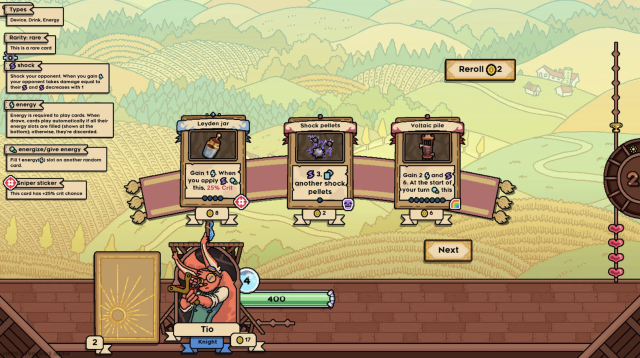
After each game in Grail, you get a choice of three ‘events’, and then a choice of another three events. The pool of different events is huge, and they even have their own rarities, with libraries and towers only turning up occasionally. These offer unprecedented levels of customisation for your cards. It’s almost silly how many different ways that you can tinker with the simple numbers and text on a card: stickers apply turn orders, among other things; augments apply additional effects; cards can be fused for stat boosts. There are three slots for ‘Traits’, which are effectively the game’s relics. These, too, can be upgraded.
This is just skimming over the surface of what you can do in these events. You can gain more gold, which is essential if you want to rock up at the game’s various shops. Your character’s health can be boosted or sacrificed for perks. Events can be effectively nullified, in the hope that they will appear super-powered in the future. It’s easy to look at Grail and think that it’s a ‘deckbuilder’ in the purest sense, since you can only really build, not play.
The second part of Grail’s plan is that it gives you innumerable tools for analysing and controlling the card-playing. You might not be able to play the cards, but you can control when they appear in the deck through stickers on the cards. You can apply effects that cause your card to reappear at the end of the deck, or to disappear from the discard pile. Git gud, and you can determine the card order of your deck. And after a game has finished (or during, if you’re a stat-junkie), you can even check the telemetry to see which cards are over- or under-performing.
Ticking Some Card Game Boxes
Without the whole ‘autopilot’ thing, Grail would have been a reasonably conventional deckbuilder. It takes the mana approach of giving you some energy to spend at the start of the game, and 1 extra energy every turn. This may or may not be enough to pay for the cards that are drawn, and you draw one card per turn. If you have a Battleaxe, for example, which needs 9 energy to play, then you will socket the energy you do have, onto the card. You might not be able to play it this turn, but you are now more likely to be able to play it next turn.

Your aim is to nudge your opponent’s health down until they have 0, and you do that through cards, rather than creatures. You can do direct damage, poison, burn effects (damage dealt when the opponent discards a card), bleed effects (increasing the damage dealt by direct damage) and more. And your cards don’t have to do any damage at all. You can build decks around discarding, applying armour, healing yourself, drawing cards, generating energy, accumulating cheese or downing carrots. There’s a love of food-produce in Grail.
On a more macro level, the aim is to kill five ‘players’ in a single run. They’re effectively the game’s bosses, but they take the form of one of the three characters you can eventually earn and play in Grail. You have four lives, so you are allowed to lose – at which point you are given another round to bulk yourself up. But you need to kill your fifth player before that final heart disappears.
Cracks Appearing In The Grail
If I were to characterise Grail, it would be as a big swing that only nicks the ball, rather than sending it flying. I love its ambition, and there are some aspects of it that should be celebrated. Anyone who is thinking about making a deckbuilder should play Grail, not only because it makes learnable missteps, but because it does some things better than any other game in the genre.
I love the deckbuilding stuff. I felt giddy standing in Grail’s engine room. There are such a slew of different ways to tinker with your deck that it’s almost impossible not to get sucked in. The game will hand you a build-making card early, and it’s so much fun to exploit it as much as possible, hunting out shops and stickers that will leverage a particular card or buff/debuff. I’d often choose a rare card as my opening event, and then nod along as it makes my build-choice for me.
I don’t think I’ve played a deckbuilder that gets the whole ‘building deck’ thing so right on its first go. It understands that people will be playing run after run, so variety is imperative. And it designs for imbalance: it’s entirely possible to make a game-breaking deck, and Grail is fine with that prospect.
As It Turns Out, Not Being Able To Play Is A Problem
But it’s everything else that keeps swinging an axe at the bottom of this deckbuilding tree. As much as ‘playing on autopilot’ is a hook that drew me in, it was also a design challenge that Sokpop Collective couldn’t overcome, at least in my view. I found myself in an awkward place: I was invested in the results of each match, and I was eager to see if individual cards were performing. But I was also quickly bored of watching the matches without interacting with them, and the telemetry – while good – still wasn’t enough to judge the efficacy of my deck. It was great at telling me which card applied buffs or damage, but not so hot at telling me whether the card enabled other cards.
What this meant was that Grail was too boring to watch, so I skipped/sped up the matches, but speeding those matches meant that I was tactically uninformed. There was no good way of engaging with these battles. Nothing felt satisfying. It’s like playing Football Manager, but having no ability to make tactical changes or substitutions, and the matches are about 10% as interesting.
The other critical issue is that on super-macro level, it’s not enjoyable enough to play run after run of Grail. It’s an issue that is completely self-inflicted. Grail makes the process of unlocking a character unnecessarily slow and onerous (and using a currency that it shares with its Battlepass, so you can easily spend currency accidentally). There are also only three characters, and they don’t differ enough in how they play. Their starting decks are the same, while 50% of their unlockable cards are different.
A Net-Positive Experience For Any Card Game Fan
The card pool is oddly obfuscated. I wasn’t sure what I was gaining or unlocking when I was playing. And this all combined to mean that I didn’t know why I was playing. Oddly, for a game full of carrots, there was no carrot tempting me into a third, fourth or more run. Grail seemed to believe that its own inherent variety – and, to be fair, it does come with a lot – was enough to bring a player back over and over. For a time, it did. Until it didn’t.
Still, I’d rather play a dozen ambitious failures than a single boring success. Grail is definitely ambitious, going all-in on a roguelike deckbuilder where you don’t actually play any cards yourself. But while it aims for the stars, it never quite leaves the atmosphere. Watching each match is grueling, and there’s not enough reasons to keep coming back.
While Grail is undeniably flawed, I am so glad I played it. It’s a real deckbuilder curio, and I’m confident that I’m going to be thinking about it for some time. And it’s going to be the game I point to whenever I think about ‘the best deckbuilders at actually building decks’.
Important Links
Buy Grail from Steam – https://store.steampowered.com/app/3597200/Grail/