


An Absolute Hoard Of Puzzles, Testing Whether You Can Have Too Much Of A Good Thing
Before coming to Order of the Sinking Star, I went back to The Witness – the previous game from puzzle maestro Jonathan Blow – to refresh my memory and remind myself of my reaction to it. It all came flooding back: the glorious Myst-like mood, the cleverness of the mechanics, and the slow, nagging fatigue of playing similar puzzles. It’s brilliant, but you can see the various mental springboards that led Jonathan Blow and Thekla Interactive to Order of the Sinking Star.
Order of the Sinking Star does structure itself around a single puzzle type – the ubiquitous sokoban, block-pushing game – but it doesn’t make the same mistake as The Witness by smudging it delicately in new directions. Stare at any given puzzle in Order of the Sinking Star and it will look distant from the others. It incorporates a vast cast of characters, all with different methods of pulling, pushing, teleporting, pocketing and sliding blocks, and then gives you a compendium of different blocks that all do a variety of things. These combinations create thousands of puzzles, but we rarely stared at any one of them and thought “did I not play something like this a moment ago?”.

Puzzles, Puzzles, Everywhere, And Not A Drop To Drink
Order of the Sinking Star is stunningly structured. You begin the game as a lone character who is struggling to understand where she is and whether it represents her death. She’s at a crossroads, mentally and literally, and it’s the literal one that we’re more interested in. Because she can head in any direction, and those directions represent different puzzle types.
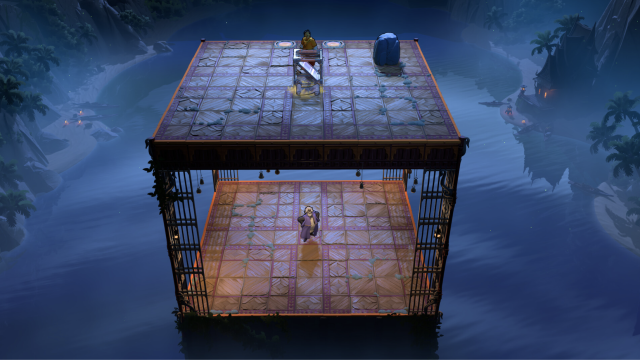
To the north, there’s a character-based interpretation of sokoban, as you control characters that deal with the blocks in different ways, and one can’t even pull or push the blocks themselves. To the east, the blocks are mirrors, and they will project one or more versions of your character that can then be teleported towards. To the south is a realm of skipping stones, as you push pebbles across water to trigger various effects, and to the west there are beams that adapt the matter of what they project onto, allowing you to walk through walls and other Portal-like gubbins.
But these are all how they begin. Mechanics layer on top – what if stealth and enemies were incorporated? – and the various cardinal directions begin to blend together. Characters get ported into the mechanics of another. Suddenly, you are carrying the learnings and nuances of one puzzle into another, and the mind throbs and threatens to pop.
Four Puzzle Games Sellotaped Into One
I have two bodily reactions to the puzzles in Order of the Sinking Star, and one is more prominent than the other. The most prominent is positive: I was constantly blown away by the cleverness of the puzzles, and how they made me feel clever for overcoming them. I have lost count of the number of times that I have stared at a puzzle in disbelief convinced that there is no possible way of solving it. But it’s in this space that Order of the Sinking Star thrives, because it likes to give you clear and communicable abilities, and then demand that you think out of the box about how they might be exploited. One character can only pull blocks, not push them, and things stick to her like glue. Initially, the ‘gluing’ aspect feels like (and is portrayed as) a curse. You constantly have to find ways to detach from blocks. But the puzzles then show the debuff to be a buff: being able to pull a second character away from situations that they themselves couldn’t deal with is a significant benefit.
And there’s thousands of these puzzles. Order of the Sinking Star is, I would suggest, about 80 hours in length, and that’s entirely dependent on whether you are going to get utterly stuck for long periods of time. I can tell you that reviewing Order of the Sinking Star before the guides have come out was a challenge, to say the least. But there was always another direction that I could head in. Order of the Sinking Star is entirely welcoming of you abandoning a puzzle or puzzle category and trying something new.

Order of the Sinking Star also has a supremely generous spirit, which is fantastic considering how punishing the puzzles can be. An Undo system is so exhaustive and game-spanning that you can actually rewind to previous puzzles and characters (so be careful that you don’t go too far). A Restart button instantaneously moves you back to the start of a puzzle (again, be careful). The Legend of Zelda-style meta-world also lets you skip, or de-prioritise, tough levels, allowing you to go somewhere else.
No Rest For The Stupid
But the other, slightly less prominent feeling that I have when playing Order of the Sinking Star is exhaustion. I mentioned The Witness at the start of the review for good reason: it’s my belief that Jonathan Blow and the team have listened to the correct feedback from that game, but made the wrong changes. The complaints about puzzle fatigue in The Witness have been addressed by a series of remixes. While the sokoban foundations are throughout the game, Order of the Sinking Star remixes them in such a vast variety of ways that they almost form their own subgenres. How can you possibly get fatigued when the puzzles are so wildly distinctive?
Well. The problem I faced was threefold: there’s such a litany of puzzles that it’s almost ridiculous; the mechanics stacked up to the point that it was hard to keep track of their edge-cases and rules; and there wasn’t much ‘lube’ to keep me persisting through those two problems. Basically, Thekla Interactive have shown what happens when you focus on puzzles and only puzzles, give a player more of them than they could ever need, and make the layouts all incredibly clever. It should be a slam-dunk, but it’s harder work than you might think.
What exactly am I complaining about? I dearly wanted something between the puzzles to act like a release-valve. The story that’s here is well written, sure, but it’s also completely abstract and mostly concerned with things that are offscreen. I couldn’t care less about who came before me, and antagonists who are just voices. Plus, the puzzles are often so heavily concerned with something that I learned twenty hours earlier. I had simply forgotten the mechanic, and there was no way to re-surface it.
Pining For The Forests Of The Witness
It’s a slightly niggly, overly critical way of saying that, if you were into The Witness or Braid for its mood, story and feelings of constant progression then you might come away feeling disappointed and a little overwhelmed by Order of the Sinking Star. It was the baggage that I carried into the game, and I suspect it is why I had a more negative reaction than most. It made me realise how much the world, story and characters matter to me.
But I want to turn the mirrors back onto the positives of Order of the Sinking Star, because it is such a marvel. I am yet to play anything like it. It’s so laden with riches that it’s embarrassing, as the saying goes. Normally a puzzle game will sacrifice something: the length of the game, the density of the puzzles, or the variety of the mechanics. But it simply isn’t the case here. It’s like being trapped in the Hellraiser cube, but the cenobite is played by Richard Osman. I don’t quite know how Thekla Interactive pulled it off.
Am I glad that I can cast Order of the Sinking Star to the side and play something else? Yes, I feel mentally gang-tackled by the wealth of the puzzles here, and there wasn’t much relief from that experience. But I will also think of Order of the Sinking Star fondly, because it’s a puzzle colossus. It’s huge, threatening and takes gargantuan effort to tackle. I’m kind of proud of myself for felling it.
Important Links
Buy from Steam – https://store.steampowered.com/app/499170/Order_of_the_Sinking_Star/